Is Your Oven Ready for Fall Cooking? A Temperature-Accuracy Guide

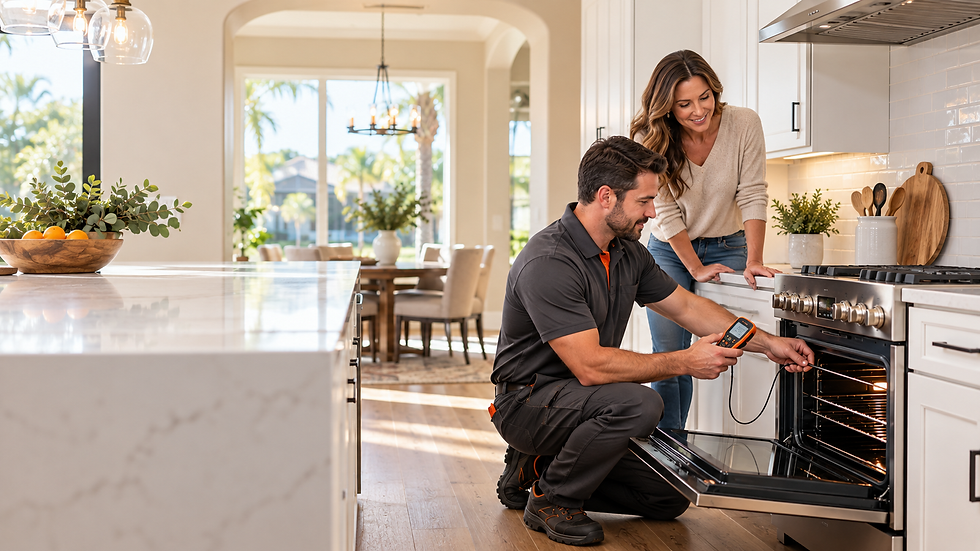
When Tampa Bay temperatures finally begin to ease, many households return to meals that use the oven more often: baked dinners, casseroles, breads, cookies, and weekend roasts. That makes early fall a useful time to notice whether the oven is producing predictable results.
An oven does not need to hold one perfectly fixed temperature every second. It heats, stops, and heats again as part of its normal cycle. What matters is whether those cycles average close to the selected setting and produce reasonably consistent cooking from one use to the next.
If familiar recipes suddenly need much more time, brown too quickly, stay cool in the center, or cook very differently from one side of the pan to the other, the issue may be more than the recipe. A careful, safe check can help you decide whether technique, cookware, rack position, or the appliance itself deserves attention.
What “Preheated” Actually Means
The preheat signal tells you that the appliance has reached a point in its programmed warm-up process. Depending on the model, the air near the temperature sensor may reach the target before the oven walls, racks, and other surfaces have fully absorbed heat.
That does not automatically mean the oven is malfunctioning. Some recipes—especially breads, pastries, pizza, and foods cooked in heavy pans—benefit from a little additional stabilization time after the signal. Follow the appliance manual and recipe directions rather than assuming every oven behaves exactly the same.
Normal temperature cycling
During cooking, the heating element or gas burner turns on and off to maintain an average temperature. A thermometer may therefore show a reading above the setting at one moment and below it later. One isolated reading does not tell the whole story.
Look for a repeated pattern across a full heating cycle. A large, persistent difference or unpredictable results across several cooking sessions is more meaningful than a single fluctuation.
A Safe Home Check for More Consistent Results
You can gather useful information without removing panels or touching internal components.
1. Start with a clean, empty oven
Wait until the oven is completely cool. Remove loose debris and wipe ordinary spills according to the manufacturer’s instructions. Heavy residue can smoke and may affect airflow, but do not begin a high-heat self-clean cycle merely as a diagnostic test.
2. Confirm the rack position
Place the rack where the recipe or owner’s manual recommends. The center rack is a useful general reference, but broiling, roasting, convection cooking, and specialty baking can require different positions.
3. Use appropriate cookware
Dark metal, shiny metal, glass, ceramic, insulated sheets, and oversized pans absorb and distribute heat differently. If results changed after you changed pans, the cookware may be part of the explanation. Avoid covering the oven bottom or racks with aluminum foil; it can interfere with airflow and damage some oven surfaces.
4. Limit door openings
Opening the door releases heat and can extend cooking time. Use the oven light and window when possible. A door that does not close evenly, a damaged gasket, or hinges that no longer hold the door correctly can also allow heat to escape.
5. Record the pattern
Write down the selected temperature, preheat time, rack position, cooking mode, pan type, and actual result. If you use a separate oven thermometer, follow its instructions and observe several readings over time rather than relying on one number.
This short record is useful if you schedule service because it shows whether the problem is slow preheating, low heat, overheating, uneven cooking, intermittent shutdown, or a difference tied to one operating mode.
Why an Oven May Cook Unevenly
Uneven cooking can have several possible causes, and the visible symptom does not identify the failed part by itself.
Heating or ignition problems
An electric oven may have a bake or broil element that is no longer heating correctly. A gas oven may have an igniter that glows but does not open the gas valve reliably or quickly enough. These components should be tested professionally rather than handled as a homeowner repair.
Temperature-sensing problems
The temperature sensor communicates heat information to the control system. If the sensor is damaged, out of position, or providing an inaccurate reading, the oven may cycle incorrectly. Some models use different sensing and control designs, so the model number matters.
Airflow and convection problems
In a convection oven, the fan helps circulate heated air. A fan that does not operate properly, blocked airflow, or overcrowded racks can create inconsistent browning. Convection settings may also automatically adjust temperature or timing depending on the model.
Door, gasket, or hinge problems
A worn gasket, bent hinge, or door that does not close squarely can release heat. Do not add an aftermarket seal or force the door into position. The correct repair depends on the oven design.
Controls or calibration
Some ovens allow a limited user calibration adjustment through the control panel. That setting is intended for a consistent temperature offset—not for an oven that will not heat, swings unpredictably, shuts down, or behaves differently from one cycle to the next. Check the owner’s manual before changing calibration, and record the original setting.
Electric, Gas, and Convection Ovens Behave Differently
Electric ovens commonly use separate bake and broil elements. Even when the bake element is the primary heat source, the broil element may participate in preheating or temperature recovery. Gas ovens typically depend on an igniter, burner, valve, sensor, and controls working in the correct sequence.
Convection models add a fan and, in some designs, an additional heating element. That extra airflow can shorten cooking time or change browning. Use recipes and settings intended for convection rather than treating it as identical to conventional baking.
These differences are why an accurate model number is valuable before an appointment. It helps identify the appliance configuration, technical information, and potential parts needed for that specific unit.
When to Stop Using the Oven or Range
Turn the appliance off and arrange appropriate help if you notice:
A gas odor. Leave the area and contact the gas provider or emergency services from a safe location. Do not operate switches or attempt appliance troubleshooting.
Smoke that is not explained by an ordinary food spill.
Sparking, arcing, melted wiring, or a burning electrical odor.
Repeated breaker trips.
A heating element that remains visibly on when the oven is turned off.
A control panel that becomes unusually hot, flashes, or behaves unpredictably.
A door that will not close securely or glass that is cracked or damaged.
Do not remove the back panel, test live voltage, adjust a gas valve, bypass a safety device, or attempt to repair a household gas-supply line. Better Homes repairs the appliance itself and does not repair household gas lines.
Preparing for an Oven or Range Service Appointment
A few details can make scheduling and diagnosis more efficient:
Photograph the complete model and serial label. It may be on the door frame, storage-drawer frame, behind the lower drawer, or another location identified in the manual.
Record any error code exactly as displayed.
Note whether the problem affects bake, broil, convection, one surface burner, or every function.
Describe whether the problem is constant or intermittent.
Mention recent power interruptions, electrical work, cleaning cycles, spills, or changes in cookware.
Clear ordinary items from the cooktop and nearby counter, but do not move a heavy range or wall oven.
Better Homes Appliance Repair services many residential freestanding ranges, slide-in ranges, wall ovens, cooktops, rangetops, and gas, electric, and convection models. Service depends on the appliance type, model, age, installation, technician capability, address, and replacement-part availability.
Oven and Range Repair in Westchase and Citrus Park
Westchase and Citrus Park include a mix of established homes, newer kitchens, remodeled cooking spaces, slide-in ranges, and built-in wall ovens. Access and installation can vary considerably, particularly when cabinetry, islands, downdraft systems, or stacked wall-oven configurations are involved.
Better Homes Appliance Repair provides service in Tampa and select surrounding Hillsborough County communities. Because appointment availability varies by address and appliance, Westchase and Citrus Park homeowners should call to confirm coverage and provide the model number before scheduling.
Learn more about oven and range repair, or review the company’s Tampa appliance-repair service area.
Better Homes is locally owned and operated, with more than 30 years of appliance-repair experience and 450+ five-star Google reviews. The standard diagnostic service call is $90. Qualifying built-in and specialty appliances have a $125 specialty diagnostic service call. The diagnostic fee is waived when the repair is completed, subject to applicable service terms. Qualifying repairs include a 90-day warranty covering the original repaired issue; the written invoice controls the applicable details.
Call 727-447-0108 or visit BetterHomesAppliance.com to confirm service for your address and appliance.
Frequently Asked Questions
1. Is it normal for an oven thermometer to move above and below the selected temperature?
Yes. Ovens normally cycle their heat source on and off, so the temperature rises and falls. The average performance over several cycles and the consistency of cooking results matter more than one momentary reading.
2. Should I recalibrate my oven if food takes longer to cook?
Not immediately. First confirm the recipe, cooking mode, rack position, pan type, preheating method, and whether the door closes correctly. Calibration may help a consistent offset on models that support it, but it will not correct failed heating, ignition, sensing, airflow, or control components.
3. Why does convection mode cook differently from regular bake?
Convection uses moving air to transfer heat around the food. It may cook more quickly or brown differently, and some models automatically convert the selected temperature. Follow the appliance manual and a convection-specific recipe when possible.
4. Can Better Homes service a built-in wall oven?
Many built-in and wall ovens can be serviced, but availability depends on the type, model, age, installation, technician capability, and parts availability. Call with the complete model number. Qualifying built-in appliances have a $125 specialty diagnostic service call.
5. What should I do if I smell gas near the range?
Do not ignite a burner, operate electrical switches, or try to locate the leak. Leave the area and contact the gas provider or emergency services from a safe location. Appliance service can be considered after the immediate gas-safety concern has been addressed.


Comments